Our IP transit and Layer 2 network solutions around London provide low-cost, high availability data centre connectivity
Browse our services
When you're looking to connect your data centre hosted equipment to the Internet, you need IP transit to provide you with a low-latency and high bandwidth connection. Our London IP transit service does exactly this, in a resilient and diverse manner to ensure 100% core network uptime. At any time we are connected to at least two upstream providers so a clear route is always available to the Internet. Through BGP, only the most direct routes are chosen for efficiency. Our network has fully redundant components and diverse connectivity to eliminate single points of failure. Our network is fully IPv6 enabled throughout.
We provide low-cost and reliable IP transit to over 20 data centres, whether you're an existing rack space customer, looking for connectivity to a rack from a third party, or are an ISP wanting another upstream provider for resilience... and from just £3/Mbps!
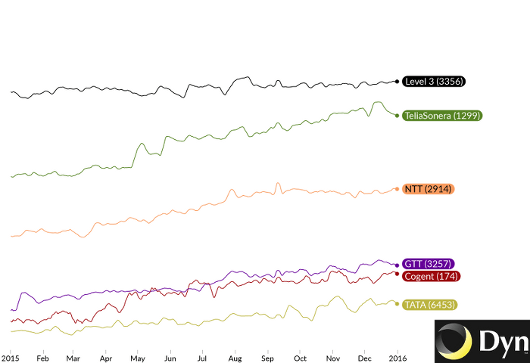
At all times we are just milliseconds away from leading Tier 1 providers, each with their own international dark fibre networks:
as well as hundreds of peers in the UK (via LINX and LONAP), Netherlands (via AMS-IX and NL-ix) and France (at PANAP). The Tier 1 providers above peer with major global providers including Global Crossing, NTT, Level(3), TeliaSonera, Sprint and Savvis ensuring exceptional global connectivity!
We bill IP transit on an industry-standard scheme known as 95th percentile committed data rate (CDR). Whilst a standard method for charging for connectivity, it sometimes causes confusion, so we'll explain it further here. Whenever we supply IP transit, we are really providing two services in one: a network uplink port (10/100/1000Mbps) and Internet bandwidth through our upstreams. Let's examine each in turn...
By Ethernet standards, network ports are fixed at 10Mbps, 100Mbps or 1000Mbps (1Gbps), and you'll typically choose the port size which is sufficient for your peak usage. For example, if you are regularly pushing about 20Mbps of data, you would choose a 100Mbps port as the lowest suitable option. If you are pushing 85Mbps, you may want a 1000Mbps port to ensure any sudden peak demand can be handled without saturating the port.
Whatever port speed you have, under normal circumstances you will be able to connect at that speed to the Internet for as long as you need to. So with a 100Mbps port, even if you are pushing 20Mbps of data routinely, you can still "burst" up to the full 100Mbps if necessary - for example, because you ran a highly successful promotional campaign to drive traffic to your website. This additional headroom is extremely useful for short-term unpredictable high demand.
To provide a reliable service, we have to ensure sufficient capacity is always reserved for our clients' typical needs. It would be prohibitively expensive and highly unnecessary for any ISP to plan for every customer pushing their full uplink port speed all of the time.
We therefore introduce the 95th percentile commited data rate (CDR), a statement ("commitment") of how much bandwidth ("data rate") you expect to need to utilise most of the time, or more precisely for 95% of the month. Under the 95th percentile model, we ignore the top 5% of your traffic usage in the month, allowing you burst up to full uplink port speed for short periods of time (up to 33-37 hours in total per month) without incurring additional charges. However, if you utilise bandwidth higher than your commited data rate for more than 5% of the month, you will begin to incur overage charges. This is because we have to provision extra capacity on our network (and in turn our upstreams on their networks) to cope with the increased demand you are placing on us.
To calculate the 95th percentile bandwidth, we sample the data (in bytes) transferred by you over our network every 5 minutes, and calculate the average rate both inbound and outbound for each 5 minute window. We then rank the samples for inbound and outbound separately, and calculate the 95% sample on each, and then choose the largest of the inbound and outbound traffic before rounding upwards to the next nearest Mbps. For example, if we measured a 95th percentile of 5.6Mbps inbound but 8.2Mbps outbound for the month, then you would be charged based on your outbound usage rounded up to 9Mbps.
We're frequently asked how the 95th percentile model compares with ISPs who charge per GB of data transfer in the month. The reason for choosing a 95th percentile model is that it ensures your committed speed is always guaranteed so your services will never appear slow provided you stay within your committed data rate (whilst you can burst outside this, we cannot guarantee the capacity is available, though in practise it usually is). When charging on the GB/month transfer model, an ISP has no idea how that usage will translate into uplink capacities - it could all be used in one day or spread evenly over the course of the month. This makes capacity planning full of guesswork and estimations - a practise we don't favour over a guaranteed reliable network.
Since data transfer is a measure of actual usage but the 95th percentile is a measure of required capacity at any instant, it is impossible to convert between the two measurements. 1Mbps CDR on a 100Mbps port can be as much as 3000GB data transfer per month, depending on traffic patterns.